
Montgomery County Criminal Court Cases
Montgomery County criminal court cases are divided by offense level. Texas District Courts hear felonies. The Montgomery County District Clerk maintains those files and provides the public District Clerk Odyssey inquiry. The county lists the 9th, 221st, 284th, 359th, 410th, 418th, 435th, and 457th District Courts with criminal jurisdiction. A felony case number, indictment, settings, motions, judgment, and sentence belong in that clerk's case file.
Class A and B misdemeanors go to County Courts at Law Nos. 1 through 6. Their records are held by the Montgomery County Clerk and searched through a different Odyssey site. Justice Courts in Precincts 1 through 5 and city municipal courts keep fine-only Class C matters within their own systems. Thus, a missing result in a county portal may simply point to a different court level. The charge shown at booking also may not match the count later filed by the prosecutor.
Two Montgomery County Case Portals
The split between the two Montgomery County court portals is the key local search rule. Start with the District Clerk site for a felony indictment. Use the County Clerk Odyssey inquiry for a Class A or B misdemeanor. Searching only one can create a false impression that no case exists. Both are free public inquiries, but each reflects the records of its own clerk.
The official District Clerk interface shows how the felony search is organized. The District Clerk source leads into this Montgomery County court image.
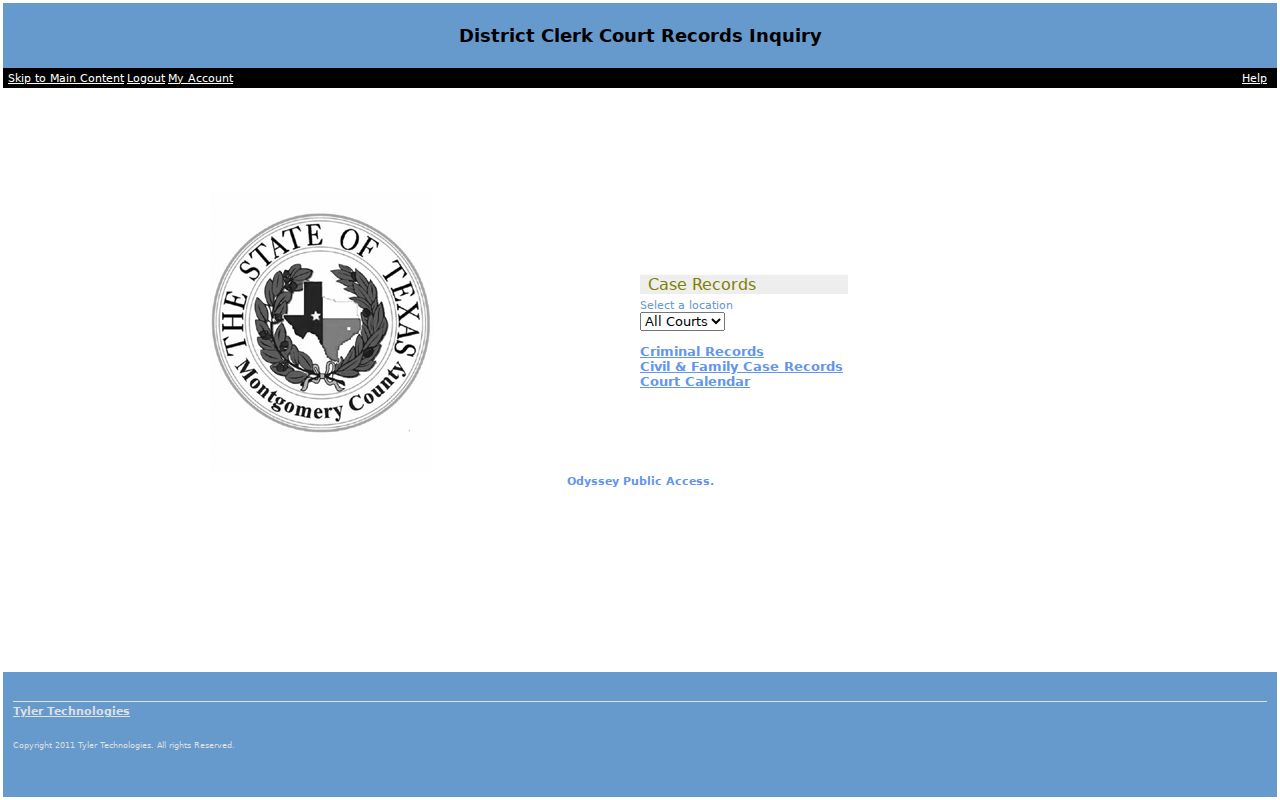
That screen is an index into a felony docket, not a certified court record or proof of conviction. Confirm the court, filing date, charge, and disposition before tying a result to a person.
Searching Montgomery County Case Records
A case number is the cleanest key for Montgomery County case records. A party-name search is useful when the number is unknown, but common names require more checks. The portal can expose case status, charges, events, hearings, and dispositions. Public access to document images varies, so the clerk remains the source for an official copy.
- Identify the likely offense level. Choose District Clerk Odyssey for a felony or County Clerk Odyssey for a Class A or B misdemeanor.
- Search by the full case number when known. Otherwise enter the last name, first name, and middle name or initial.
- Narrow the result with a filed-date range, location, case type, or status when those controls are available.
- Open the Montgomery County docket and compare the court, filing date, charge, events, and final disposition.
- Contact the correct clerk for an unavailable image, plain copy, or certified copy. Municipal and justice matters stay with their issuing court.
The two Odyssey searches share a practical set of fields documented in the county research.
| Field Label | Type | Required | Notes |
|---|---|---|---|
| Location | Select | Yes | Choose the court or clerk location offered in the session. |
| Case Number | Text | No | Most precise search key when known. |
| Last Name | Text | Name search | Use the spelling in the filed case. |
| First Name | Text | No | Narrows a party-name search. |
| Middle Name | Text | No | Useful for common names. |
| Date Filed From/To | Date | No | Limits the Montgomery County filing window. |
| Case Type/Status | Select | No | Available values depend on location and session. |
Montgomery County Criminal Court Levels
Eight listed District Courts and six County Courts at Law handle the two main levels of Montgomery County criminal cases. The number of courts does not change the custodian rule. Felony files route through the District Clerk at 501 North Thompson Street, Suite 105, Conroe, Texas 77301, phone 936-539-7855. County misdemeanor files route through the County Clerk at 210 West Davis Street, Conroe, Texas 77301, with routing in the official county phone directory. The Montgomery County government directory is the safest starting point when a room or department changes.
Fine-only matters sit outside that pair. A Conroe citation, for example, belongs with Conroe Municipal Court, while a precinct matter belongs with the relevant Justice Court. Statewide re:SearchTX can supplement local searches, but its coverage and access to documents vary by court and user role. It should not replace a direct check of both Montgomery County Odyssey portals.
Inside a Montgomery County Case File
A Montgomery County criminal case file is organized around a court case, not a person's full arrest history. It can show the filed complaint, information, or indictment; party and attorney entries; settings and motions; plea or trial events; judgment; sentence; and financial entries. Some dockets name a filing but do not offer the underlying PDF. Sensitive fields and sealed material remain outside ordinary public display.
| Case Number & Court | Identifies the file, assigned Montgomery County court, filing date, type, status, and judicial officer. |
|---|---|
| Charging Document | Shows the complaint, information, or indictment and the filed counts, class, degree, or statute where entered. |
| Docket Entries | Lists filings, bond actions, settings, motions, plea, trial, judgment, sentence, and warrant events. |
| Hearing Dates | May show hearing type, date, time, courtroom, and judge. |
| Disposition & Judgment | Records the outcome for each charge, such as conviction, dismissal, acquittal, or deferred adjudication. |
| Sentence & Conditions | States punishment and may show community supervision, fines, costs, restitution, and related orders. |
Note: A portal result is an index, while a certified copy from the correct clerk is the stronger proof of a Montgomery County outcome.
Reading Montgomery County Case Dockets
Docket labels need context. “Disposed” means a court entered a disposition, not that the defendant was convicted. A dismissal ends that charge without a conviction. An acquittal follows a not-guilty result at trial. Deferred adjudication follows a guilty or no-contest plea while the court postpones a formal finding of guilt during supervision. It remains publicly disseminable in Texas unless sealed.
A “true bill” means a grand jury returned an indictment. A “no bill” means the grand jury declined to indict, which is not the same as an acquittal. A capias is a court command to arrest, often after a case event. Read the charge line, event sequence, disposition, and judgment together. One label rarely tells the whole Montgomery County court story.
- Arraignment
- The stage when the charge is presented and a plea is taken.
- Disposition
- The recorded outcome of a charge or case.
- Adjudication
- A formal judicial determination.
- Nolle prosequi
- A prosecutor's decision not to proceed, often shown through dismissal terms.
How a Criminal Case Moves
A Montgomery County case may begin with an arrest or summons, followed by prompt magistration. Texas law generally requires an arrested person to be taken before a magistrate without needless delay and no later than 48 hours. The magistrate addresses warnings, probable cause, counsel, and bond. That outside limit is not a promise that the whole case or release process will finish in two days.
The prosecutor then decides what charge to file. A misdemeanor may proceed by complaint or information. A felony commonly moves through a grand jury indictment. Arraignment, discovery, pretrial motions, plea talks, or trial follow. The court then records a disposition and, when applicable, a sentence. Post-judgment motions and appeal can add later entries.
Case flow: Charges Filed › Arraignment › Pretrial › Plea or Trial › Disposition › Sentencing
Missing Montgomery County Case Images
A docket can list a complaint, order, motion, or judgment without giving the public a free image. That does not mean the document is absent from the Montgomery County file. Contact the clerk that owns the case and give the case number, court, filing date, and document title. Ask whether a plain or certified copy is available. The research did not locate a current consolidated copy-fee schedule, so obtain a written quote from the clerk rather than assuming a price.
The County Clerk's separate official-record product can also cause confusion. The GovOS official-record search is useful for clerk records, but it is not a substitute for Odyssey criminal-case research. Its source interface is shown below.
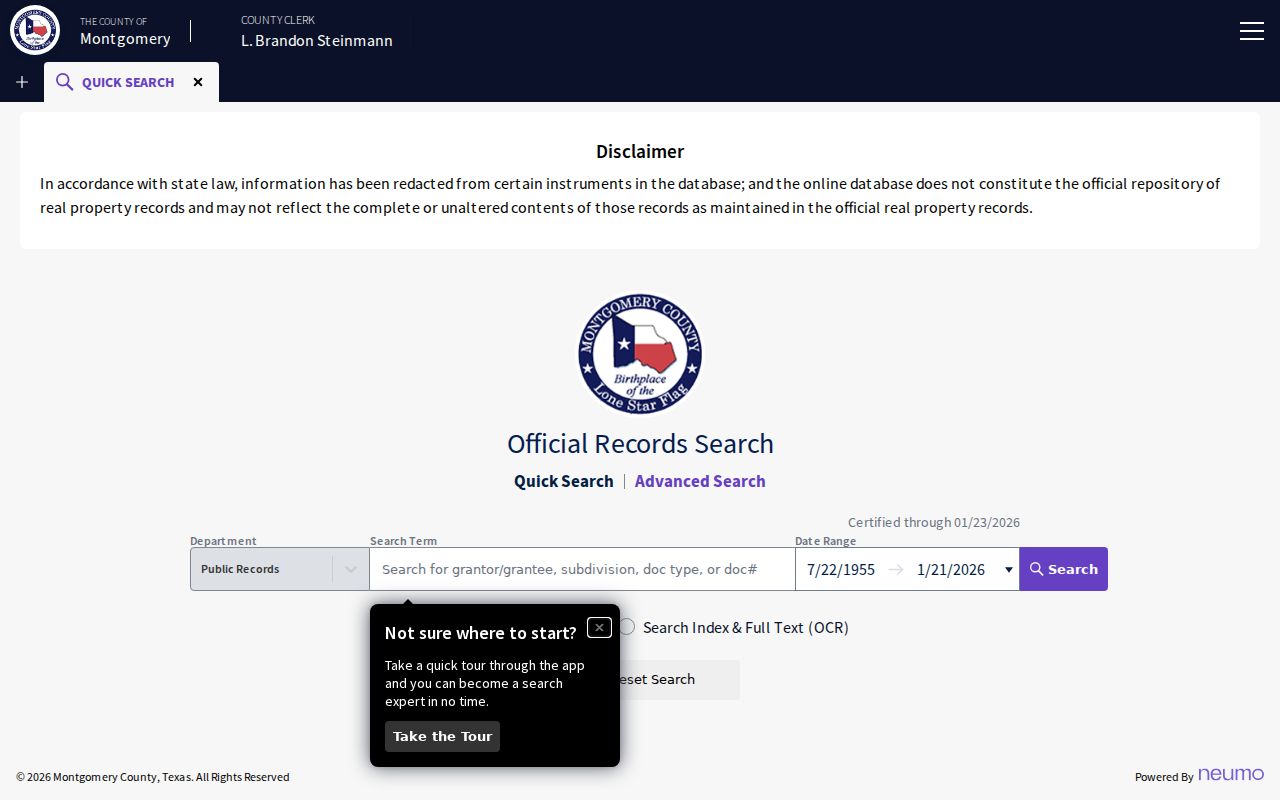
The separate screen reinforces why a reader must identify the record type and custodian before treating a database miss as a missing case.
Montgomery County Certified Case Copies
Use a certified Montgomery County court copy when proof of the filed charge, judgment, dismissal, or sentence matters. A screenshot may be useful for navigation, but it does not carry the clerk's certification. The District Clerk handles felony copies. The County Clerk handles Class A and B misdemeanor copies. Municipal and justice clerks handle their own fine-only files.
Request the exact item instead of asking the clerk to research a legal question. Good identifiers include the case number, party name, assigned court, filing date, and document title. If the goal is to reconcile an arrest with the later prosecution, compare the arresting agency report and booking record with the certified court disposition. The broader Montgomery County arrest lookup explains those earlier custody records.
The County Clerk misdemeanor portal provides the public starting point. The County Clerk source leads into the Montgomery County case-search screen.
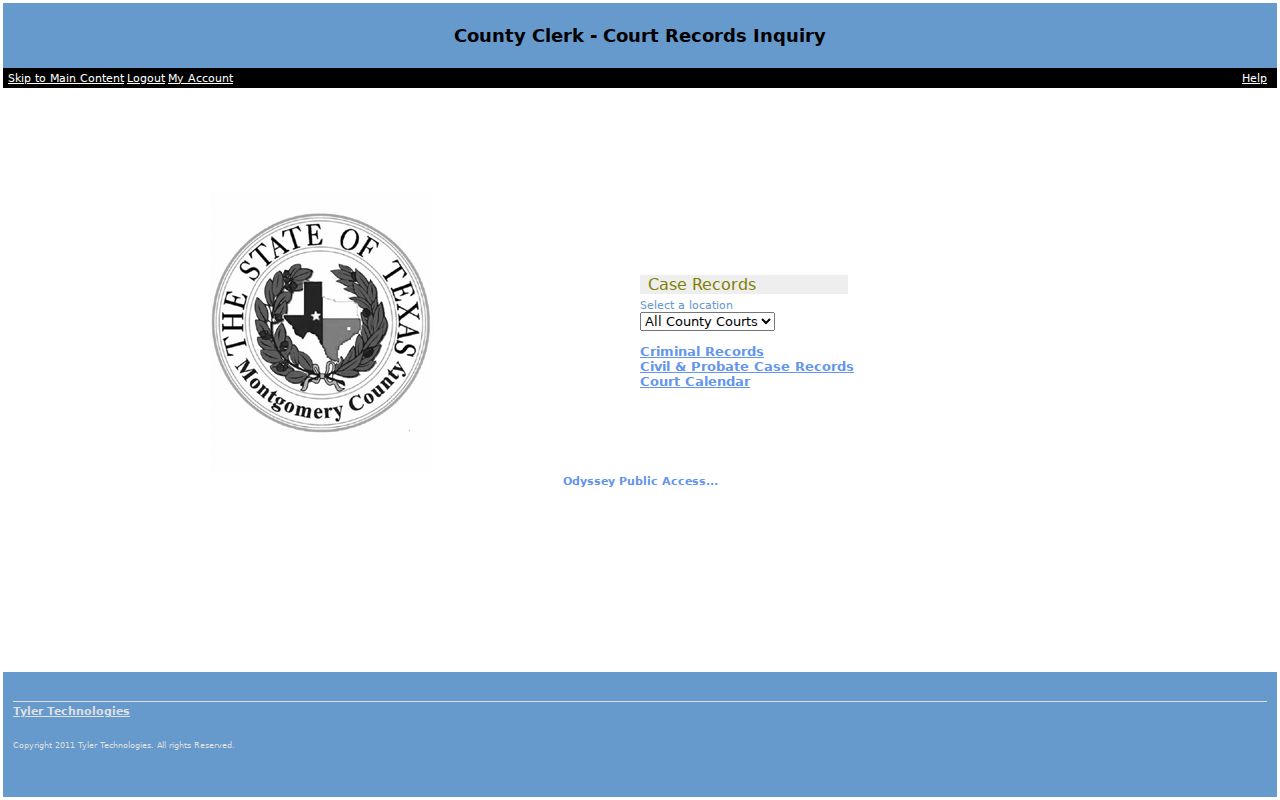
Use that result to identify the file, then ask the County Clerk for the specific certified record needed.
Case Record Access & Restrictions
Texas court records are generally open under the judicial access framework, but public access has limits. Sealed and expunged matters, juvenile information, victim and minor identifiers, full Social Security numbers, protected driver data, and other sensitive fields may be withheld or redacted. Online access can be narrower than access at the clerk counter. A blank Montgomery County search therefore does not prove that no restricted file exists.
The Texas Public Information Act governs many agency records, while judicial records can be handled under the Montgomery County district-court rules and the judiciary's court-record access resources. A request should seek an existing document, not ask the clerk to create an analysis. For an eligible person's own record, an expunction under Code of Criminal Procedure Chapter 55A may direct named agencies to return or destroy records. Nondisclosure restricts ordinary public release but does not destroy every file.